
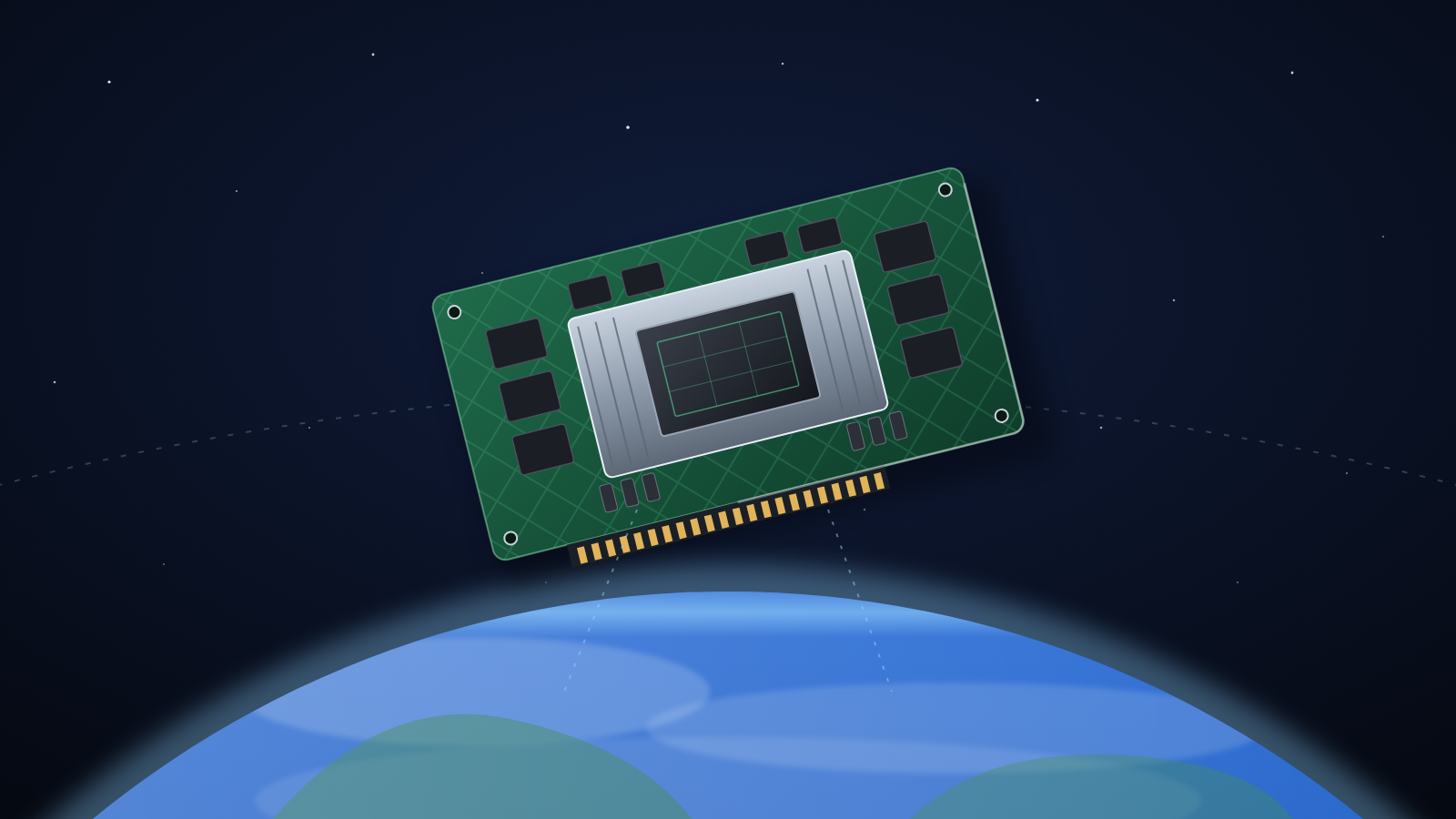
Space edge computing: what has actually flown, and what is only promised
The space industry spent the autumn talking about orbital data centres. Beneath the announcements, a quieter change has already happened: there are now dozens of GPU modules in orbit, doing inference on satellites, today. This post separates the two.
What has flown
The clearest evidence is in Earth observation. Planet has launched eight Pelican spacecraft carrying Jetson modules since January 2025, with a ninth on its way to the launch site in September. Kepler reports 40 Jetson Orin modules across ten satellites in its relay network. Smaller payload computers from Aethero, Exo-Space and EDGX have flown on rideshare missions since 2024, each with a Jetson Orin inside.
At the other end of the scale, Starcloud flew a single H100 data-centre GPU on Starcloud-1 in November 2025. That is one device, not a data centre, but it proved a 700 watt accelerator can be powered and cooled in orbit for a while.
Our own count, from company statements read at source on 19 October, is 58 GPU-bearing modules attributed to named spacecraft, with two more claimed by a supplier whose host satellites are not public. It is not a census and not a market size. It is the number you get when you refuse to count a press release twice.
What was announced this month
On 1 October, Orbitworks, the Loft Orbital joint venture, launched the first spacecraft of a planned 50-satellite constellation. Each carries two Jetson AGX Orin modules and is reported to run a Mistral language model on board, sending down what it finds rather than the raw imagery. The release describes the platform as open to third-party applications. Fifty satellites is the plan. One has flown.
The same week, SpaceX disclosed figures for its Starlink Gen3 architecture: a 250 kilowatt power system and 10 terabits per second per satellite, with onboard compute. The compute detail, a Vera Rubin NVL72 system per spacecraft, comes from a reply by Elon Musk on X rather than a filing, and reports disagree on whether he posted it on 20 September or 1 October. Prototypes are reported for early 2027. This follows the August announcement of Starmind AI1, a satellite compute payload built with NVIDIA on Rubin GPUs, with a first launch targeted for late 2027. Targets, not bookings.
Google's Project Suncatcher, announced in November 2025, plans two prototype satellites on Planet's Owl bus carrying TPUs, to test models and optical links between spacecraft. The published target is early 2027. A September report puts the first on SpaceX's Transporter-18 rideshare, which we have not been able to confirm from either company. Planet's own description of the work is risk reduction, not a commercial service.
Transporter-18 is also reported to carry MOI-1A, a sub-50 kilogram satellite from India's TakeMe2Space with Jetson Orin NX processors, offering onboard compute to customers.
The counterpoint
Not everyone is chasing GPUs. A June piece in Via Satellite reports startups investing in hybrid onboard computers and network switches instead of space servers, on the argument that power, cooling and radiation make a terrestrial GPU design the wrong starting point. The Earth observation record above supports a narrower version of that view: what has flown and worked is the small, integrated edge module, not the rack.
What does this mean for the future of Space and AI?
The near future of AI in space is small GPU modules on satellites deciding what to send down, not orbital data centres, which remain 2027 targets with the physics unsolved. As more spacecraft carry a processor, the hard part stops being the chip and becomes getting a model onto it: rebuilt for the flight computer, verified against the cloud original, and proven to be what was tested, hundreds of times over. A wrong model in orbit is a mission outcome, so trust becomes the product, and whoever makes that trust cheap and repeatable will be in every mission that follows.
Sources
Figures on flown hardware are from company releases read at source on 19 October 2026. News items are as reported in the outlets below, retrieved 22 October 2026; where two reports disagree, the text says so.
Kepler: kepler.space, "Kepler deploys first space-based scalable cloud infrastructure powered by NVIDIA"
Planet: launch releases for Pelican-2 (January 2025) to Pelican-12 (September 2026), planet.com
Starcloud: starcloud.com/starcloud-1; IEEE Spectrum, "NVIDIA's H100 GPU takes AI processing to space"
Loft Orbital: "Orbitworks launches the first large scale AI-native constellation open to third-party applications", October 2026
SatNews, 4 October 2026: "SpaceX unveils 250 kW Starlink Gen3 AI satellites"; Teslanorth, 20 September 2026, on Musk's post
Interesting Engineering, August 2026: "Nvidia to build Starmind AI1 satellite compute payload for SpaceX"
Via Satellite, 6 November 2025: "Google targets in-space computing with Project Suncatcher"; Space Explored, 5 January 2026: "Planet and Google explore computing in orbit"
Electronics For You: "India takes edge computing into orbit" (TakeMe2Space MOI-1A)
Via Satellite, 2 June 2026: "Are orbital data centers the next frontier of AI infrastructure?"

Space Edge Computing - What Has Flown

How to Build the Digital Plumbing on the Moon: The Challenges and Opportunities of Lunar Exploration

Space and AI: A Collision of Challenges
Get the latest Updates
Space Edge Computing - What Has Flown
How to Build the Digital Plumbing on the Moon: The Challenges and Opportunities of Lunar Exploration
Space and AI: A Collision of Challenges